Tuesday, April 26, 2011

Lazlo Moholy-Nagy CHERYL VAN HOOVEN


CHERYL VAN HOOVEN
b. 1948 Chicago, Illinois
From the beginning, Cheryl Van Hooven's intentions in photography have been twofold: first, to cross the barrier between herself and the photographed object, and secondly, to expand the technique, boundaries and definitions of the medium. The artist had been working on a series of photograms when she began adding light drawing to enhance dimension. Using a penlight to draw directly onto photographic paper, Van Hooven moved from light drawing as tool to Light Drawing as subject, at which point the technique became inseparable from the content. "I am interested," says Van Hooven, "in the ability of photography to be both a handmade object and the opposing notion of infinite reproduction; the mechanically photographic versus the personal line; the dialectic between the rational and the irrational."
Van Hooven received her B.A. in Journalism from the University of Georgia, Athens in 1970. The following year, she was awarded a fellowship at the Graduate School of Sociology and Anthropology at Emory University in Atlanta. Van Hooven has worked as a free-lance photographer for magazines, including Interview, Details, and Vogue Italia.
Artwork from top to bottom:
Untitled (Light Drawing), 1985
unique drawing with light on photographic paper
Untitled (Light Drawing), 1985
unique drawing with light on photographic paper
Untitled (Light Drawing), 1985
unique drawing with light on photographic paper
Untitled (Light Drawing), 1985
unique drawing with light on photographic paper
Untitled (Light Drawing), 1985
unique drawing with light on photographic paper
Untitled (Light Drawing), 1985
unique drawing with light on photographic paper
http://www.carleton.edu/campus/gallery/exhibitions/2001/NOTphotograph/hooven.html
Gerald Walsh
 http://www.lucemograph.com


Sunday, April 24, 2011
Baliant's Lightbox..and Paul Bourke


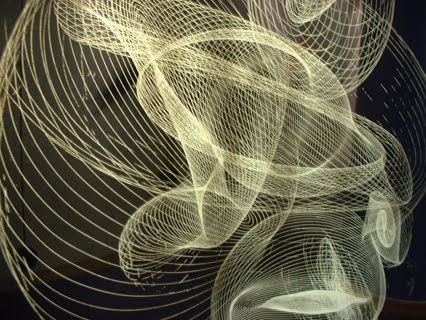
These drawings were made using a complex array of inter-connected pendulums that move a needle that etches away paint on a sheet of glass. The movement of the pendulum is called Simple Harmonic Motion and due to the complexity of variables in the drawing mechanism, each drawing is completely unique. The devices are made and invented by the artist and are types of harmonographs that use gravity as a force to make unique patterns. The images are the results of traces of the time, movement, and the artist’s interaction, whilst the pendulum is pulled to equilibrium by the Earth’s gravitational pull. These gravity-induced drawings hint at recognizable images found in nature that have also been formed by this universal force. The earth’s gravitational pull is harnessed to produce completely unique forms that often resemble images not dissimilar from ones found in astronomy.


 http://picapoint.com/balintbolygo/artwork.php?title=shm_lissajous
This is a drawing/projecting mechanism that creates images (Lissajous curves) using twin elliptic harmonic movement. The movement of a pendulum and its deflecting pendulum result in a fine point scratching a fine layer of carbon off a sheet of glass. With the aid of an overhead projector this process is instantaneously transferred into a light drawing. The images are the results of traces of the time and movement whilst the pendulum is pulled to equilibrium by the Earth's gravitational pull. These gravity-induced drawings hint at recognizable images found in nature that have also been formed by this universal force. The soot that is on the glass relates to Carbon being an abundant component of life and also of the Universe. The earth's gravitational pull is harnessed to produce completely unique forms that often resemble images not dissimilar from ones found in astronomy. The drawings created with this piece are have been made into light boxes.
oh and back to Paul Bourke..
http://paulbourke.net/geometry/harmonograph/
All initial amplitudes, frequencies (w) and phases (p) should be different and not integer multiples for the most complicated (interesting) patterns.
In order for the amplitude to decay (not necessary but occurs in the real harmonograph) the amplitudes can decay as follows, where d is typically a suitable small positive number. This gives an exponential decay function.